Every sleep article says the same thing. Go to bed at the same time every night. Get eight hours. Wind down for an hour beforehand.
Cool. You worked until 11:30 on Tuesday, you close on Friday and open on Saturday, and Sunday you were up with a kid at 3am. Which same time did you have in mind?
Sleep advice is overwhelmingly written for people with regular office jobs and no dependents. If that's not you, most of it is unusable, and reading it produces mainly guilt. So here's what's actually available when your schedule genuinely can't be fixed.
(If you're falling asleep during the day, snoring heavily, or waking gasping — that's a medical conversation, not a habits conversation. Sleep apnea and similar conditions are common, under-diagnosed, and treatable. No routine fixes them.)

The one lever: your wake time
If you do nothing else, do this.
Anchor your wake time. Not your bedtime.
This is counterintuitive because bedtime feels like the thing you control. But your body clock is set primarily by when you wake and when you see light — not by when you get in bed. You can lie down at 10pm all you like; if your clock says it's mid-afternoon, you'll stare at the ceiling.
The wake time is what does the setting. So pick one, roughly, and hold it — including weekends, including after a bad night.
Especially after a bad night. This is the hard one. You slept four hours, you feel destroyed, and sleeping until 11 feels like medicine. What it actually does is push your clock later, which makes tonight worse, which makes tomorrow worse. That's the mechanism by which one bad night becomes a bad fortnight.
Get up at your normal time. Be tired today. You'll sleep tonight, and the system resets. It's a bad day in exchange for not losing a week.
If your wake time genuinely varies — shift work, a newborn — aim for the smallest range you can. A two-hour window beats a six-hour one, and "as consistent as this job allows" is a real goal even when "consistent" isn't.
Light is a drug and it's free
Light is the strongest signal your body clock has, and almost nobody uses it deliberately.
Get bright light early. Within the first hour of waking, get outside. Ten minutes. Even overcast — outdoor light on a grey day is vastly brighter than indoor lighting, by a factor most people find hard to believe. Your kitchen is dim as far as your body's concerned.
This does two things: it sharpens you now, and it sets a timer that makes you sleepy roughly a set number of hours later. Morning light is, functionally, how you schedule tonight.
Dim things down at night. Not just screens — overhead lights. Bright light in the evening tells your body it's still daytime, and it doesn't much care that you have opinions about this.
The screen thing is somewhat overhyped, honestly. The blue light from a phone is a real but modest effect. The bigger problem with your phone at midnight is that you're reading work email or watching something engaging — the content is keeping you awake more than the wavelength. A boring book on a bright screen will beat a gripping argument on a dim one.
If you work nights, invert it: bright light during your shift, and take the sunglasses seriously on the drive home — you're trying to not tell your body it's morning. Then blackout curtains. This is a real strategy that shift workers use and it does help, though nobody should pretend night shifts are easy on a body.
Sleep pressure: the second system
Two things drive sleep. The clock is one. The other is sleep pressure — a chemical that builds the whole time you're awake and gets cleared while you sleep. The longer you're up, the more pressure, the sleepier you get.
Understanding this explains two things people get wrong.
Long naps wreck your night. A nap dumps your accumulated pressure. Nap for ninety minutes at 5pm and you've spent the sleepiness you needed at 11. Keep naps under about 25 minutes and before mid-afternoon, and they'll help without stealing from tonight.
Caffeine blocks the signal, not the substance. Caffeine doesn't remove the pressure — it just stops you feeling it. The pressure's still accumulating behind the blockade. This is why the crash exists: the caffeine wears off and all of it arrives at once.
Caffeine also lingers far longer than people assume. A meaningful fraction of a 3pm coffee is still in you at bedtime. If you're not sleeping well, a hard cutoff eight hours before your target sleep time is one of the higher-yield experiments available, and it costs nothing to try for a week.
When you can't be consistent
Real situations, real approaches.
Rotating shifts. The most important thing is direction: rotating forward (days → evenings → nights) is easier on the body than backward, because it's easier to stretch a day than compress one. If you have any say in the roster, ask for forward rotation.
A newborn. Nothing here applies and it's not a failure. Sleep when you can, get someone to take a shift so you get one unbroken four-hour block, and know that this is temporary in a way that doesn't feel temporary at 4am.
Wildly variable work. Anchor what you can. Even if your bedtime swings by four hours, the same wake-up plus the same morning light does more than you'd think. Anchor the routine even when you can't anchor the clock — same sequence, whenever it happens.
Social jet lag. If you're up until 3am on weekends and 6:30am on Mondays, you're giving yourself a transatlantic flight's worth of clock shift every week. Tuesday is going to be bad and it isn't a mystery. You don't have to give up your Saturday — but a two-hour swing costs much less than a five-hour one.
The bed rules that actually matter
Bed is for sleep. Not work, not scrolling, not the argument. Your brain builds associations between places and states, and if bed is where you worry, lying down will start to trigger worrying. That's a learned response and it's how a bad fortnight becomes chronic insomnia.
If you're awake more than about 20 minutes, get up. This feels wrong. It's the single most effective technique in the evidence-based treatment for insomnia, and the logic follows from the rule above: every minute spent lying awake and frustrated teaches your brain that bed means being awake and frustrated.
So get up. Go somewhere dim. Do something boring. Go back when you're sleepy. It'll feel counterproductive for about a week and then it works.
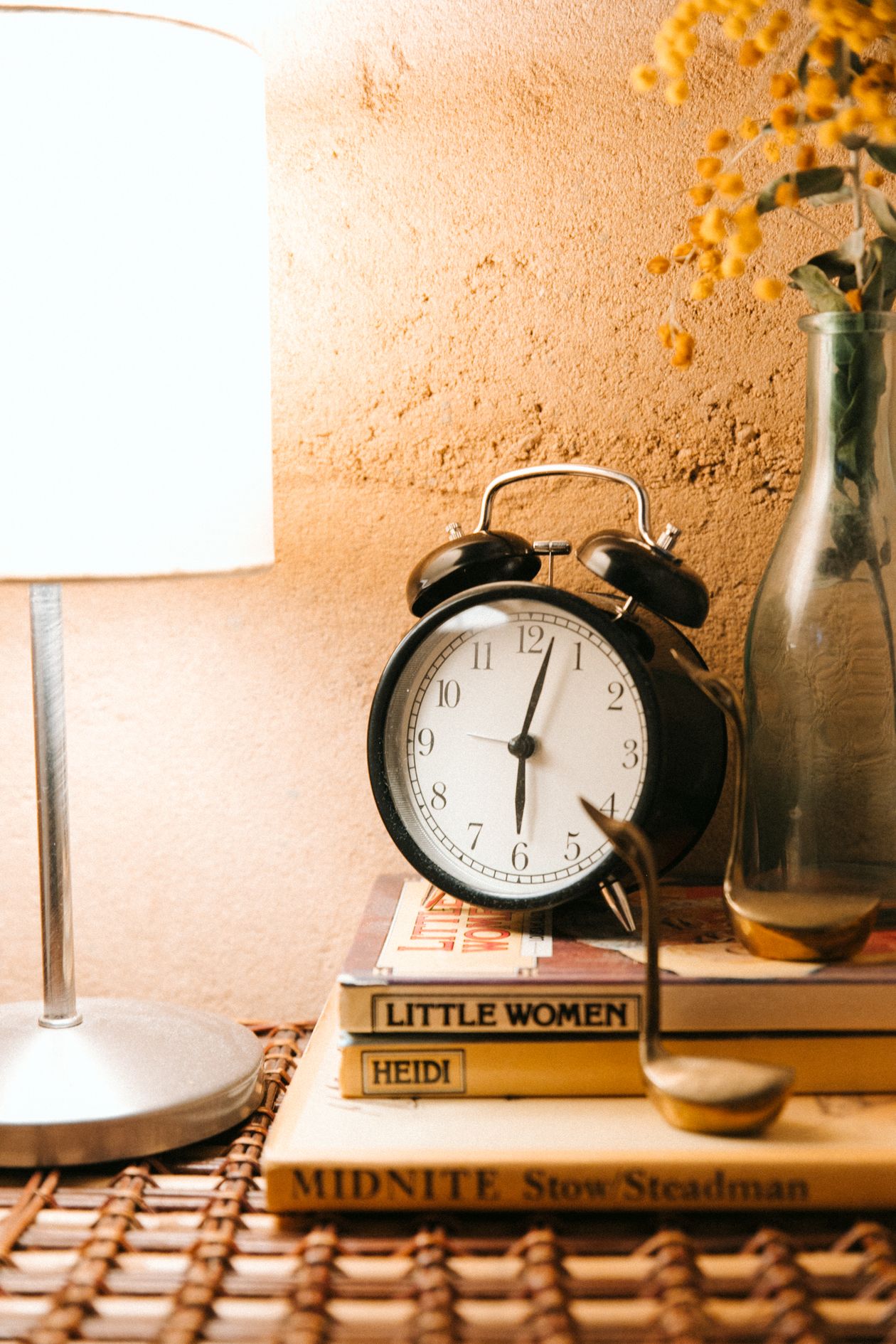
Don't look at the clock. It's 3:40 and you have to be up at 6:20 and now you're doing arithmetic about how wrecked you'll be. That arithmetic is arousing, and arousal is the opposite of sleep. Turn the clock around.
The thing nobody says
Some seasons of life just involve bad sleep. A newborn, a crisis, a job with an unfixable roster.
You can't optimize your way out of a genuinely bad situation, and the wellness framing — that sleep is a discipline and yours is a personal failure — is both wrong and cruel when your schedule isn't yours to set.
What you can do is stop making it worse. Anchor the wake time where you can. Get the light. Move the caffeine earlier. Get out of bed when you're not sleeping. Those four are free, they're compatible with almost any schedule, and together they're worth more than every supplement in the shop.
The rest is patience, and the acknowledgment that some months are just going to be like this.
Our guides are researched, written, edited and fact-checked in-house. Ascendance Co. is an independently owned publication based in London, United Kingdom, covering personal growth across mind, body, soul, relationships, career, performance, finances and parenting. Every article is reviewed by a second member of the team before it is published.

.png)





0 Comments