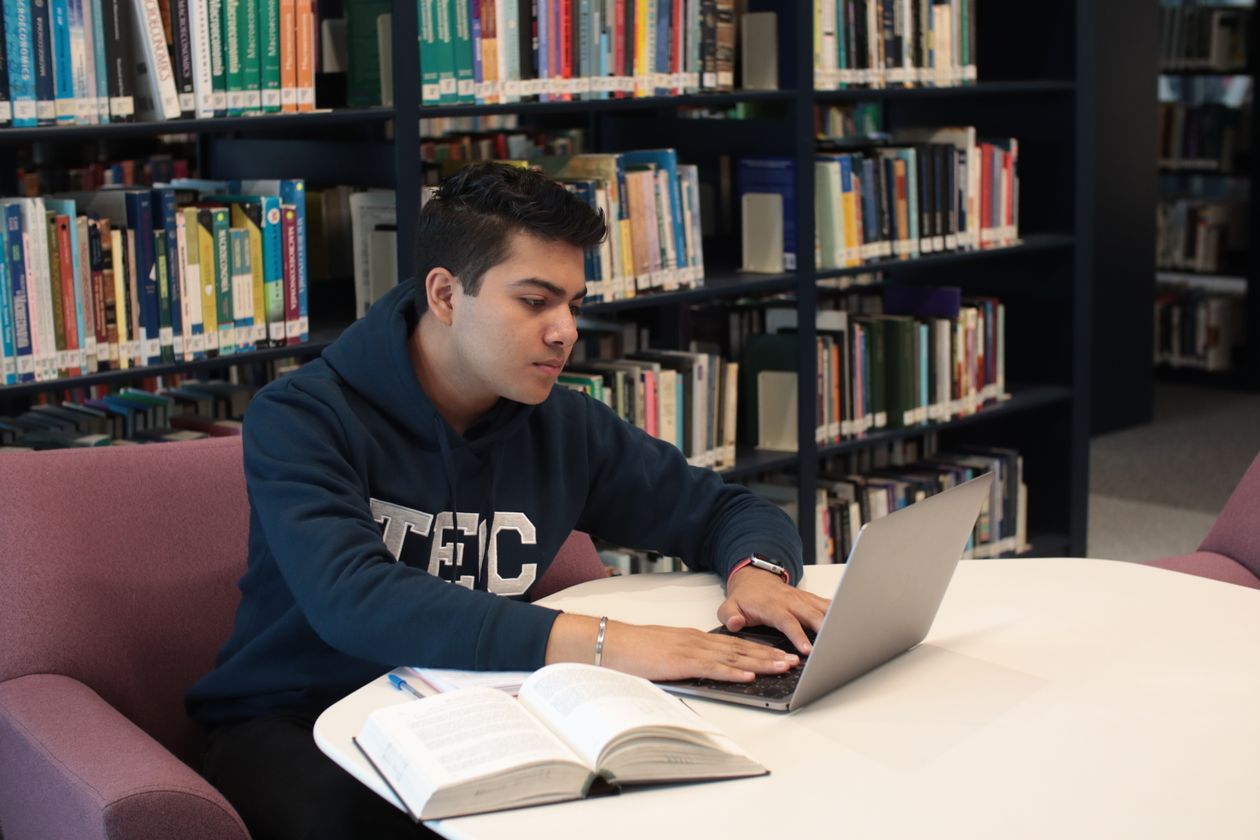
You sat in the library for eight hours. You reread the chapter twice. Your notes are beautiful. Your highlighter game is immaculate.
Then the exam asks you something slightly sideways and your mind is completely blank.
This happens constantly, and the reason is genuinely counterintuitive: the study methods that feel the most productive are, by a wide margin, the least effective. And the methods that work feel like failing.

The fluency trap
Here's the mechanism, and it explains most of what goes wrong.
When you reread a chapter, it gets easier. The sentences feel familiar. You recognize the ideas. Your brain reads that familiarity and concludes: I know this.
You don't know it. You recognize it. Those are completely different, and the exam tests one of them.
Recognition is passive — it's the ability to identify something when it's put in front of you. Retrieval is active — it's the ability to produce something from an empty page. Rereading trains recognition beautifully and retrieval not at all. Which is why you can nod along to every page and then freeze at question three.
This is called the fluency illusion, and it's the single biggest reason smart students underperform. It's not that they're lazy. It's that they've spent eight hours doing something that reliably generates a feeling of knowledge without the knowledge.
Active recall: the thing that actually works
The fix is almost annoyingly simple. Close the book and try to produce the answer.
That's it. Instead of reading the chapter again, shut it and write down everything you can remember. Then open it and see what you missed.
This will feel terrible. You'll produce a fraction of what you expected, and you'll conclude that you don't know the material and that this method has revealed you to be behind.
But look at what actually happened: you didn't just discover a gap. The act of straining to retrieve — even when you fail — is what builds the memory. The struggle is the mechanism, not an obstacle to it. Retrieval practice is one of the most consistently supported findings in the learning research literature, and it beats rereading in study after study, usually by a lot.
The catch is that it's unpleasant and rereading is pleasant. That's the entire reason most students do the wrong one.
How to actually do it
The blank page. After a lecture or chapter, take a blank sheet and write everything you remember. No notes. Ten minutes. Then check what you missed and write those in a different colour. The different-colour items are your actual study list — everything else, you already have.
Turn your notes into questions. As you take notes, write them as questions rather than statements. Not "The Krebs cycle produces 2 ATP per glucose" but "How much ATP does the Krebs cycle produce per glucose, and where does it happen?" Now your notes are a test instead of a text.
Explain it out loud to nobody. Say the concept aloud as if teaching it. The moment your explanation gets vague and hand-wavy, you've found the exact boundary of your understanding. You cannot bluff out loud the way you can bluff internally — internally, everything sounds coherent.
Do problems before you feel ready. For anything quantitative, attempting a problem and failing teaches more than reading three worked solutions. Reading a solution feels like learning and is mostly watching.
Spacing: the second lever
Retrieval is what to do. Spacing is when.
Cramming works — for about 72 hours. Then it's gone, which is why you remember nothing from last semester.
Spaced repetition means revisiting material at increasing intervals: a day later, three days later, a week, two weeks. Each time, you retrieve it cold, which is harder and therefore more effective.
The practical version doesn't need an app or a system. It needs you to touch each subject briefly, multiple times, instead of once at length.
Concretely: four one-hour sessions across four days beats one four-hour session. Same total time. Substantially better retention. The only thing that changed is the distribution.
There's a bonus here worth noticing. Spacing works with how forgetting operates. Each time you almost forget something and then retrieve it anyway, the memory gets more durable. So the forgetting between sessions isn't a bug you're fighting. It's the thing that makes the next session work.
Interleaving: the one that feels wrong
Study one topic until you've mastered it, then move on. Right?
Actually — mixing topics within a session tends to work better, even though it feels much worse.
Blocked practice (all of topic A, then all of topic B) feels great. You get into a rhythm. Your accuracy climbs within the block. Interleaved practice (A, B, C, A, C, B) feels choppy and you make more errors.
But blocked practice hides something: you know what kind of problem is coming, so you never practice the hardest part — figuring out what kind of problem this is. On the exam, nobody tells you which chapter a question came from. Interleaving is the only way to practice that.
The errors during interleaving aren't a sign it's not working. They're a sign you're practising the thing you'd otherwise skip.
The three-hour structure
Here's what a good session looks like.
Phase 1 (20 min) — Retrieve cold. Before opening anything, blank page. What do I remember from last time? This is your warm-up and your diagnostic in one.
Phase 2 (60 min) — Encounter new material, actively. Read or watch, but stop every ten minutes and ask: what did I just learn? Say it out loud. If you can't, you weren't paying attention and rereading it now, while it's fresh, is cheap. Rereading it in a week is expensive.
Break — 10 minutes, and get up. Not your phone. Actually stand. The consolidation that happens in a genuine break is real, and scrolling isn't a break — it's more input.
Phase 3 (60 min) — Test yourself. Problems, questions, explaining aloud. This is where the learning actually lands. If you skip this phase, you've done a reading session, not a study session.
Phase 4 (10 min) — Write down what you got wrong. This list is the most valuable object you'll produce all day. It's the only thing you need to look at tomorrow.
Three hours. Roughly 40% of it is you struggling to produce answers, which is roughly 40% more than a typical eight-hour library day contains.
The phone protocol
None of the above survives contact with a phone in your pocket.
Every interruption costs far more than the interruption — you're paying to rebuild the mental context you'd assembled, and for genuinely difficult material that rebuild takes minutes, not seconds. Six phone checks an hour means you never get deep enough for the hard thing to click.
Do not rely on willpower. Willpower is a bad plan because it's a resource you're already spending on the studying.
Put the phone in a different room. Not face-down on the desk — a different room, or a bag, or a drawer across the library. The friction has to be physical, because the check is not a decision. It's a reflex, and you don't beat reflexes with resolve.
If you need your laptop, use whatever blocking tool you'll actually leave on.
Why nobody does this
Because it's harder, and the difficulty is front-loaded.
Rereading is comfortable. You feel competent the whole time. Active recall makes you feel stupid for the first twenty minutes of every session — you keep discovering what you don't know, over and over, which is exactly what's supposed to happen and exactly what nobody enjoys.
The eight-hour library day is emotionally easier than the three-hour retrieval day. It's just less effective at the thing you're there for.
The trade
You get your evenings back. You do three focused hours instead of eight foggy ones, and you walk into the exam able to produce rather than merely recognize.
The cost is that studying stops being comfortable. You spend the whole time slightly failing, which is the sensation of learning and always has been.
Highlighting felt better. It just didn't work.
Suman Dhamala owns and publishes Ascendance Co, a personal-growth website covering mind, body, soul, relationships, career, performance, money and parenting. Articles provide general educational information.

0 Comments