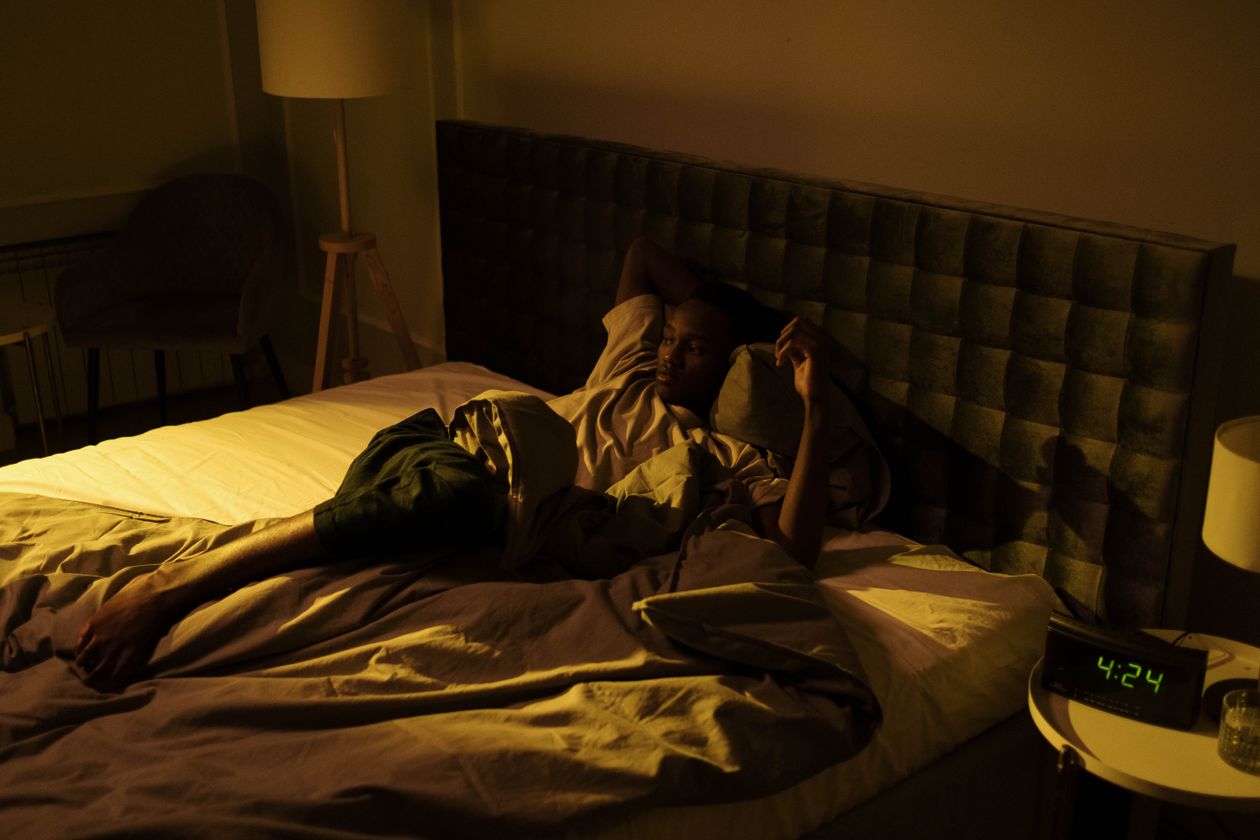
It's 2:14. You've been awake since 1:30, and your brain has selected tonight to review a thing you said in a meeting three weeks ago, an email you haven't sent, whether that mole has changed, and the entire architecture of your career.
None of this is urgent. All of it feels urgent.
And the cruelest part is you know it's not rational. You know that at 9am none of this will have the same weight. Knowing that changes nothing, which is its own small horror.

Why 2am is different
Something real is happening, and it's not a character flaw.
Your prefrontal cortex — the part that handles perspective, proportion, and "actually that's fine" — runs on resources that are depleted at 2am. The threat-detection machinery does not have this problem. It's fine. It's on.
So you're running a threat detector with the brakes off. Everything gets flagged, and nothing gets contextualized. That's why the exact same worry that feels manageable on a Tuesday afternoon feels like a crisis at 2am — it's not that the worry changed. Your capacity to hold it in proportion did.
This is worth knowing because it changes the strategy. You cannot think your way out at 2am. Your thinking equipment is offline. Every attempt to reason with the worry is a bad-faith negotiation with a system that isn't currently capable of reason, and it will lose, and you'll lie there for another hour.
Stop arguing with it
Here's the first move, and it's counterintuitive.
The instinct is to resolve the thought. To settle it. Let me just figure out whether that email was rude, and then I can sleep.
You will never get there. Because the thing generating the worry isn't a question waiting to be answered — it's an alarm, and answering one question just prompts the next. You resolve the email and it moves to the meeting. You resolve the meeting and it moves to your career. It's not a queue you can clear. It's a machine that produces items.
So don't engage on content. Engage on the level of the machine.
Defusion: get a step back from the thought
There's a technique from a branch of cognitive therapy called cognitive defusion, and it works at 2am specifically because it doesn't require you to be smart.
The idea: you're not trying to change the thought or disprove it. You're trying to change your relationship to it — from being inside the thought to observing it.
The labelling move. Instead of the thought "I'm going to get fired," think: "I'm having the thought that I'm going to get fired."
That sounds like semantic games and it does something real. It re-frames the thought as an event happening in your mind rather than a report about the world. There's now a small gap between you and it, and the gap is where sleep lives.
Push it further if you need to: "I notice I'm having the thought that I'm going to get fired." You're now two steps back — there's a thought, and there's you noticing it.
The naming move. Give the pattern a name. "Oh — this is the 2am Career Show." "Here's the Replay Channel again."
Naming it does two things. It makes it a recurring, familiar thing rather than a fresh crisis. And it's slightly funny, and humour is genuinely deflating to dread.
The silly voice move. Say the worry, internally, in an absurd voice. A cartoon character. A sports announcer.
This feels stupid and it's remarkably effective. The thought's power lives partly in its tone of authority. Strip the tone and a lot of what remains is just words.
Note what none of these do: none of them argue. You're not proving you won't get fired. You're just declining to be inside the thought.
The written worry protocol
This is the most practical thing here, and it has two parts — one at 2am and one earlier in the day.
At 2am: park it
Keep paper and a pen by your bed. Not your phone — the phone is a portal to more input and the light and the temptation are both against you.
When the thought arrives, write it down. One line. Then write the time you'll deal with it: "Tomorrow, 6pm."
That's it. Go back to sleep.
The reason this works is that a lot of 2am looping is your brain trying not to lose something. It has flagged an item as important, and it can't put it down, because putting it down means forgetting it, and forgetting it feels dangerous. So it rehearses. Over and over. That's what the loop is — a memory function stuck on.
Writing it down discharges that. It's on paper. It won't be lost. The rehearsal has a reason to stop.
You have to actually look at the paper tomorrow, though. If you never do, your brain learns the paper is a lie and stops accepting it.
In the daytime: worry on purpose
The prevention half, and it's the part that actually reduces frequency.
Schedule fifteen minutes a day — same time, not near bed, say 6:15pm. This is Worry Time. Sit down with the list and worry deliberately.
Not solve. Worry. Look at each item and let yourself be anxious about it, on purpose, for fifteen minutes.
Two things happen. First, worry is much less compelling when it's mandatory — there's something about being told to do it that takes the charge out. Second, and more usefully, your brain begins to trust that the items get processed, so it stops raising them at 2am. The middle-of-the-night alarms are, in part, your brain's response to never being given a proper hearing.
For each item, sort it: is this a problem or a worry? A problem has an action. A worry doesn't. If it has an action, write the next single step and schedule it. If it doesn't — if it's "what if I get sick," "what if I never find someone" — there's nothing to do, and the honest answer is that this is a fear to be carried rather than a task to be completed. Naming that is itself useful.
Get out of bed
If you've been awake more than about twenty minutes, get up.
This feels like giving up on the night. It's the opposite, and it's the core of the standard evidence-based treatment for insomnia.
Here's why: your brain builds associations between places and states. If you spend hours in bed anxious, bed becomes the place where you're anxious. Lying down starts to trigger the state. That's the mechanism by which a rough fortnight becomes a chronic thing that lasts years.
So get up. Go to another room. Keep it dim. Do something boring — a dull book, folding laundry. Not your phone, not anything with a plot.
Go back when you're actually sleepy, not when you think you should. And if it happens again, get up again.
The small stuff that helps
Turn the clock around. It's 3:47 and you have to be up at 6:30 and now you're calculating exactly how bad tomorrow will be. That arithmetic is arousing, and arousal is the opposite of sleep.
Try a boring cognitive task. Count backwards from 300 in sevens. Name a country for every letter. Something with just enough demand to crowd out the loop and not enough interest to wake you up. This works better than "clear your mind," which is an instruction nobody has ever successfully followed.
Slow your exhale. Breathe in for four, out for eight. The long exhale nudges your nervous system toward the calmer setting. It's not magic and it's not nothing.
Accept the night. Sometimes the most effective move is: okay, I'm awake. That's tonight. I'll be tired tomorrow and I'll survive it. An enormous amount of 2am misery is not the wakefulness — it's the fight against it, and the fight is what keeps you up.
When it's more than a bad night
Take this seriously.
If this is most nights. If the worry runs all day and not just at 2am. If it's affecting your work, your relationships, your ability to get through ordinary days. If you're avoiding things because of it.
That's not an overthinking problem you fix with technique. That's what anxiety looks like, and it's common, and it responds well to treatment — CBT for insomnia and for anxiety are both well-supported, and they work.
Talk to a doctor. Not because it's severe, but because there's no reason to spend three years white-knuckling something that a professional deals with routinely.
Tonight
If it's 2am right now and you're reading this on your phone: put the phone down.
Write the thought on paper. Write "tomorrow, 6pm" next to it. If you're still awake in twenty minutes, get up and go read something dull in the other room.
None of it will feel like enough. It's still the right thing to do, and 9am is closer than it seems — and at 9am, the whole thing will be about a third the size. It always is.
Suman Dhamala owns and publishes Ascendance Co, a personal-growth website covering mind, body, soul, relationships, career, performance, money and parenting. Articles provide general educational information.

0 Comments